Showing posts with label social studies. Show all posts

Friday, July 5, 2013

Primary Sources: The Perfect Fit for Informational Texts in the Common Core

I've been focusing a lot lately on informational texts as we move towards the Common Core adoption that is pretty much going into full swing next month, and with good reason. The informational text / literature split is very important moving forward, and failure to give it its proper due and focus heavily on it might actually cost you your job a few years down the road, it IS essential.

At the beginning, I focused a lot on resources. Where can I find informational texts? Are there resources out there for how I can use them properly in my classroom? I've already done some posts about this (see: Informational Text Free Digital Resources and The Informational Text Revolution).

Now, I'm starting to think about the connection to other subject areas (another major key in the CCSS). I've always considered myself a social studies teacher. Yes, I'm an elementary school teacher who teaches, and does a pretty darn good job of teaching, all subject areas. BUT, social studies, especially history, has always been my primary passion, and as my instruction in social studies has evolved to the point of students doing multiple research based projects, presentations, and doing some deep, relevant, technology and personally driven learning about history, geography, sociology, and economics, I've thought about how this all fits the CCSS.

I'm going as far as to say that implementing the CCSS in social studies might be the most exciting part of the CCSS adoption for me personally... well, it's actually pretty close between that and the changes it demands of math instruction from kindergarten all the way through 12th grade.

Social studies instruction is already built for informational text. Honestly, I think most of us in the elementary grades might not go deep enough with our instruction, or with student expectations when doing research, but that's not really the point here.

The point here is simple: Primary sources. The more I've been thinking on this subject and studying it, the more I am convinced that 5th grade students can read and analyze primary sources, and it's exciting. Some of the primary examples I've seen of implementing the CCSS in 5th grade involve reading and analyzing the Gettysburg Address, Martin Luther King Jr.'s "I Have A Dream" speech, and other great primary sources.

So with that in mind, I'm going to just throw some information and resources out there that I think can benefit all of us. I'll be listing a quick description of each of these multiple links:

These first links are to research articles, and other descriptions of the importance of primary sources within the CCSS:

Finally, I'm going to end with some resources that can be used with students, or can get you thinking more about using primary sources in your classroom:
  • Teaching With Documents, Lesson Plans : From the National Archives website, there's some decent lessons here that really help when developing your own lessons. A good place to start.
  • Using Primary Sources in the Classroom : A great pdf document from the Library of Congress that lists some great lesson ideas and some examples.
  • Primary Sources for the Classroom : A pdf document from the state of Tennessee that might be my favorite of everything I've listed here. There's some stuff I want my students to read and take to heart as they start researching.
  • Library of Congress Common Core Teacher Resource Center : If you don't know about this, wake up! This huge listing of resources can't be ignored. I've been referring to it often. It's growing daily, and there are tons upon tons of great things there, not just for primary sources, for ALL the Common Core.
  • Evaluating Sources : Another pdf document, this one is helpful and I think your smarter 5th graders could handle without too many problems.

Tuesday, January 22, 2013

History Webs: A Great Social Studies Project Idea

My 5th graders just finished Civil War History Webs. This little project only takes a few periods of work, and really involves creativity and writing.

I found the idea for History Webs in "Super Social Studies," a Scholastic teacher guide that has served me very well over the years (I HIGHLY recommend this little book, it's amazing).

I don't want to quote directly what they call a history web, to respect their copyright, but as I've changed it up quite a bit from what is discussed in this book, I'll let you know about my version of this great project. BUT, you should go buy this guide, it really is one of the most used resources in my possession.

To make a history web, I recommend the large construction paper (I use the 12" x 18" paper that my school keeps in stock). You want your students to draw a rectangle in the middle of the paper, and from there, divide the paper into however many sections you want them to (I've done 4, 6, and 8). I recommend 6, it's a good number for drawing pictures, they don't come out too small at that size.

However many sections you've divided the paper into is how many different topics you will assign. We just completed these for the Civil War, and their options to choose from included (but were not limited to): Abraham Lincoln, the Battle of Gettysburg, the First Battle of Bull Run, General Lee, General Grant, General Stonewall Jackson, the Emancipation Proclamation, the end of the war, the battle of the Ironclads, Lincoln's Assassination, the Underground Railroad, Harriet Tubman, the fall of Richmod, Sojourner Truth, and Nat Turner. You can obviously choose many other things for this.

The assignment for students is to research each of their six topics (or four, or eight, depending). Students will be asked to draw a color picture depicting the topic, and write a paragraph in their own words about that topic, either on the back of the paper or on index cards.

Here are a few examples of exemplary work. Some have the work on index cards, and some have it written on the back:


Sunday, January 20, 2013

5th Grade Civil War Unit

As I always do when finishing a new unit, I will post the content here as a post within the main pages of my blog. Unit 5: The American Civil War, which includes topics on slavery, the war, two nations, Abraham Lincoln, and reconstruction, exists as a page that is called Fifth Grade Civil War Unit. It is also listed in my subject listing under Social Studies. For those of you who like to get what you came for, you can find that entire post in its entirety listed below:


My fifth grade unit on the Civil War attempts to take students through the topics of slavery, including the roots of slavery, horrors of slavery, and the Underground Railroad. From there, we talk about the political beginnings of the Civil War, and spend the majority of the unit in a timeline taking us through the major battles, important people and events, and ending with the assassination of Abraham Lincoln.

SLAVERY IN THE CIVIL WAR

I like to start the unit with the portion on slavery. I have two posts in my old literacy blog titled Teaching A Unit on Slavery in Intermediate or Middle School (Part 1: Picture Books), and (Part 2: Literature Selections) that you can refer to for some great ideas. I have a few books that I enjoy reading aloud to the students, and that they learn a lot from.

I always start the unit by reading From Slave Ship to Freedom Road, a Julius Lester book that, while it is a picture book, is definitely hard hitting and doesn't hold back. It's a great way to set the tone for teaching about slavery if you intend to show the horrors and injustices of slavery in a way that will get through to elementary students but won't overwhelm them. (there aren't really any "free" versions of this book out there, but it's definitely worth the $6 or so that you'll spend getting it on Amazon or through one of the links on Google shopping).

I also read Under the Quilt of Night by Deborah Hopkinson. This story is a great, appropriate for almost any age telling of a family on the run on the Underground Railroad. This book is available in my schools library, and might be available in yours too, it's a common book (it's in the easy section). Finally, I read Almost to Freedom by Vonda Micheaux Nelson, it's a great story of a runaway girl and her family told from the perspective of the little girls doll. This book actually stuck with many of my students more than the others for some reason.

Now, granted, the topic of slavery is deserving of its own unit, and I will eventually get there. I always expand on this unit when we get to the civil right era. I've found that my students in 5th grade seem to understand the complexity and importance of slavery in the United States when I pair it up with the civil right era. Because honestly, more than half the class always thinks that Martin Luther King Jr. ended slavery before I teach them differently. I'm going to list a few of the more high quality resources about slavery here, that you can use as part of a Civil War unit, it's own unit, or like me, a mixture of Civil War and Civil Rights.
Now, let's move on to the Civil War itself. In my class, I want students to understand the causes of the Civil War, the difference between the Confederate Army and Union Army, the basic timeline of events, and how the world recovered afterwards. With that being said, let's move on to some great resources:

THE CIVIL WAR
  • American Civil War Resources: A listing with online quizzes and games. There's another listing of great resources at surfnetkids
  • The Civil War for 5th Graders: A great little site done by a teacher. It plays out kind of like a web quest, with some good, kid friendly information presented in an easy to understand format. 
  • History Channel Civil War Interactive: You can always count on the History Channel to have great interactives of the highest quality. I'm using this one as students learn more about the differences between the two armies, battles, etc. It's all here, and it's well done. 
  • NY Times Civil War Interactives: There's a few great resources here, some about the war, some about life during the Civil War, and some about Lincoln. 
  • Battle Casualties Map: Hosted by the Washington Post, it's a great map that shows casualties on a map in a timeline format. 
ABRAHAM LINCOLN
Finally, as we go through the unit, I have students complete a 6 part "history web," a little project that I will post more on as we finish them up this week. It's a great small project.

I will also have my students complete a "gallery walk," an idea I took from Lessons With Laughter. I will also amend this posting with more information on that when it's completed. 

Wednesday, December 5, 2012

My Oregon Trail Story of Survival and Daring on the Apple IIe

I sat down tonight to write a post with great materials for the unit we're currently doing in social studies. I got a few sentences in and realized it all seemed very familiar. So, I paused for a minute, and went digging into my blog archives, and found out fairly quickly why I was struck with this sudden sense of deja vu.

I already posted the entire unit, over three months ago. Yikes. I've officially reached the point where I can't remember what I've already done on this simple little blog of mine. I guess simple isn't the correct word. It's not exactly Wikipedia, but with over 110 posts, it's getting big for me.

In any case, what I wanted to share is a quick story, and a link to a great online game that kids love.


I grew up in the 80's and 90's. When I was in elementary school, we had a computer lab. We're specifically talking about 1989-1990 here, so it was a magical time before the internet, the era of the Apple IIe, the ones with the green only screens. The first computer game I had a chance to play, and master (or kill all of my friends through various ailments and injuries). Of course, I'm talking about the original Oregon Trail.

As a 3rd grader, I couldn't get enough, this game was fantastic. It was the right balance of strategy, trail riding, and friend bruising. We got graded based upon our performance. It was great, my first experience with digital learning.

Now, here we are, in 2012, in the middle of the golden age of the computer and internet. My students have access to the knowledge of the human race within the walls of my classroom, although they don't know that, all they care about is Youtube videos and Angry Birds... who am I kidding, that's all I care about as well. All joking aside, let's move this little story along.

I teach a unit on Westward Expansion each year around this time (you can find that unit HERE). We watch a great documentary about the Donner Party (check it out in that unit if you're interested), and they do a research project on some of the major trails that were used to make the journey west, as well as the Homestead Act, the California Gold Rush, and a few other major events/laws.

One thing seems to stick with them more than anything else every year I teach this unit. You see, on day two of the unit, I fire up the laptop and projector, and we play a game together. We play the original Oregon Trail. For the first ten minutes or so, the kids look at each other and giggle at how completely and totally honky tonk this game is. The graphics are ancient, the sound effects are ridiculous, in short, this is exactly the kind of game that students of today picture their parents playing when they were kids. But they sit and watch.  They see me enjoying the game, and laugh as I make a ridiculous epitaph on the gravestone of the first member of my party to die.

Finally, they get their own crack at this gem of a game. And without fail, they play this game during their free time for the rest of the school year. Right now, my students are literally begging me to play Oregon Trail.

So, how can you play Oregon Trail? The first way is to go buy an Apple IIe, hook it up, and go find a floppy disk (remember those?). If you don't want to do that, and trust me, YOU DON'T, there's an easier way.

Head to Virtual Apple, make sure your Java is updated, and enjoy the game right there in your browser.

You know you want to. Go ahead.

Monday, December 3, 2012

Our Finished American Revolution Video (A Masterpiece)

As I discussed in my plans for Social Studies Unit 3: The American Revolutionary Period, the entire unit revolves around a video that students work on that includes re-enactments of various major events from the American Revolution (click that link up there for more information). Well, the video is done. Now, a little disclaimer on this. The video making software I use is not free, and takes some technical know how to master (it's called CyberLink Power Director). I did most of the video editing on my more powerful desktop computer at home, and the student clips and sounds were all filmed on, believe it or not, my smartphone (sadly, it was my phones swan song, I went and got my new phone just a few days after we finished filming). The videos that I added in, and songs as well, were taken from Youtube. It's a grey area in my opinion, taking copyrighted material and using them in educational videos. It's a discussion I want to see out there more often, but in my own opinion, there's no profiting from the video, it's simply educational, and students loved this one.

I used a few websites to assist me here. For the songs I needed, I found them on Youtube, and converted them to mp3 using Youtube to Mp3. It goes without saying that I deleted these files when the video was completed.

Also, for the Youtube clips, I used KeepVid, a great tool that lets you download videos from Youtube in high quality.

Later this week, we have invited parents to join us for a showing of the video, which will be shown in the cafeteria on the big projector screen.

I wanted to show off this little gem here as well. I'm adding it here from my Google Drive, the file itself is a 1.3 gigabyte .mpg file, but it should stream. Check it out! Thanks go out to everyone who created the material we researched and borrowed from for this great learning experience.


Tuesday, November 13, 2012

5th Grade Social Studies Fair Projects: A Great Presentation Based Project

Next up in a growing line of project based research and presentations that are based around social studies will be the schools 5th grade Social Studies Fair. I've been doing the social studies fair for my entire career, and this is the first year that my colleagues in 5th grade will be joining me for this great project.

We've already done two presentation based projects this year, the 50 States Presentation, and the just finished Famous Individual Presentation. Both projects involve a ton of research and synthesis, and the major burden of work and learning on these projects falls on the shoulders of the students. These are great because while I consider them "social studies," they involve reading and writing, and are multi-disciplinary to the point that I had students working on them at all different times during the school day.

I am again going to ask students to cite sources and complete a bibliography in the APA format. I had a few parents who looked at me like I was crazy when I told them that their children would be completing APA reference pages, but they have done them, and done them correctly, so we're moving forward. I have already posted some great Research Project Resources that can get any teacher started with having students research appropriately and go the extra mile in documenting their research in any area.

This project mimics the presentations that students all over the world do for Science Fairs. Students will be purchasing a science tri-fold board, and either working alone or with a partner to complete their project board.

This project was left pretty open ended. First, I explained the emphasis of this project, either history, culture, invention, geography, or ideas. Students were not allowed to do a state, the cultures we have already studied, or any famous individual that was researched for the last project. Topics range from the history and evolution of computers to research about Pearl Harbor. I make it a point to push students in the direction of topics that aren't too broad, but not too obscure, they need to be able to find sources out there.

When the day comes for the presentations, students will be setting up, again in Science Fair format. We'll set up all the poster boards, and will invite guest to join us. Other classes from the school, parents, the community, and dignitaries will be invited to view their great work. Each student or pair of students will create some note cards to guide them in the presentations they will be making numerous times on the day of the Social Studies Fair.

I have included photos of two poster boards done last year. I will post some of the ones that will be done this year (we just began work today), they should be a little more in depth than what I had my students do in previous years.


Finally (and what 99% of you are here for), I have the documents for download:

SOCIAL STUDIES FAIR PROJECT (pdf): This document is what we're using. If you like what you see, I recommend downloading all of these documents in the zip file below so that you can modify it in any way you see fit.

SOCIAL STUDIES FAIR PROJECT ZIP FILE (this file contains all the pages of the above pdf in .doc format.

Please check back around the second week of December when I will post some of the students finished work and pictures from the social studies fair.


Saturday, October 6, 2012

5th Grade Social Studies Unit 2: Discovery and Founding of North America (Colonists)

5th grade Social Studies unit 2 is about the early American colonists and pilgrims. This unit focuses on the journey, hardships, and early society that was developed when founding the initial colonies in America. This unit is listed in my Social Studies 9 Week Plans page, and has its own Unit Page. For convenience purposes, I will post the entire text of that unit here as well:


Unit 2 of 5th grade social studies covers the discovery and founding of America, focusing heavily on the colonists and pilgrims.
For me, time is usually a focus on this unit, because I like to spend more time on the American Revolution, and the 19th and 20th centuries.
With that in mind, I provide three days of instruction on the front end, familiarizing students with the topics and major events of this time period, then I hand over the learning to my students for some project based research.

The project students work on for this unit is a whole class collaboration that is presented in book form and titled "Colonial Life." The project is done in pairs, with each group preparing two pages "textbook style" on their topic.
What I mean by textbook style is a stylized presentation like that of most textbooks, in which the content, photos, illustrations, graphs, etc. all exist in the pages together.

I do not write up any student information handout for this, and they are graded on the simple research rubric that we utilize throughout the year (access the simple research rubric in either .pdf and .doc format).

The topics that students cover in their research include:

  • Colonial Towns: Buildings, layout, variety of towns, defenses.
  • Journey by Sea: How the colonists / pilgrims reached the America's, including challenges, living conditions, etc.
  • The 13 Colonies: A quick research on the original colonies, including founding dates, and a map of the original 13.
  • Crime & Punishment: The crimes that were most common, and their punishments.
  • Native Tribes: A quick research on the native tribes of the area, and their interactions with the colonists.
  • Religion in the Colonies: How religion influenced life and politics in the colonies. Also, what religion meant on a day-by-day basis to the colonists.
  • Colonial Food: How they grew food, and what the typical colonial meal looked like.
  • The Lost Colony of Roanoke: This topic fascinates many students, so I have a group take a look at its history and present some pages on it.
I'm going to present a few links to assist teachers and students alike in research or teaching of the colonial era of American history:
Finally, watch these videos in succession. These are taken from the America: The Story of Us documentary series.


Again, we normally pace this unit fairly quickly. Each group of students is responsible for a two page contribution to our "Colonial Life" book. Finally, if you like how your books turn out, head over to Student Treasures, and order a few free publishing kits. This company will make a free classroom hardbound copy of the book, and your only obligation is to send home a letter to your parents asking them to buy a copy of the classroom book. There are no buying requirements, and the classroom hardbound copy is free regardless of how many parents order. It's a great opportunity that we'll be taking advantage of.

Thursday, October 4, 2012

Famous Individual Project: A Great 5th Grade Research Project With Tons of Activities and Rubrics

Recently, our students in 5th grade completed their first oral project presentation of the year, presenting their individual state posters, the project they did in the 50 states unit,
in front of other students. We asked students to dress for the occasion, and graded them on everything from their posture, the volume of their voice, and the way they dressed. This ended up being a great experience, and we've decided to build on that during the school year.

Next up, we will be doing a Famous Individual project. In this project, students will be completing research on a famous individual of great character. They will be analyzing their individual according to the 7 Habits of Highly Effective People, a program that my school began following this year. Below you will be shown the requirements for this project, including links to all necessary forms. To download everything in one packet, click here:


This project will ask students to:
  • Choose a famous individual, either living or dead, who is not fictional. Once they have chosen their famous individual, they must complete the Justification Page to explain why they believe their individual showed good character and lived a life that benefited others. 
  • Once the students has successfully justified why they have chosen an appropriate person for this project, they will begin research. Students will be taught how to properly cite sources and create a bibliography (this is a big step for 5th graders, but they can do it). First students will learn how to take notes and keep track of sources. I came across a great packet online to help with Note Taking that I will be utilizing. They will use the blank bibliography cards to cite sources, and then will be given the biography outline packet, which will guide their research. Students research papers will be scored based upon the 5th grade research paper rubric.
  • Next, students will be creating a computer based presentation that will supplement the speech they will be giving. We will be doing these presentations in the computer lab with the assistance of our schools computer lab instructor. They will be scored on their computer presentation based on the computer presentation scoring rubric.
  • Finally, in the final step of this project, students will create a short speech to go with their computer presentation, and they will be presenting these projects before other students, parents, and community members. The speeches will focus on the character of their person, their major accomplishments, and how they fit the 7 Habits. The speech will be scored based on the oral presentation scoring rubric
I am very excited to see our students continue to step up. They did a great job on the 50 state projects (as you can see HERE), and I expect great results on this project. 

I have all of these forms available in Microsoft Word format, if you would like any of them, please let me know and I'll get them to you. As always, this is available freely, I believe that teachers should share our resources with one another free of cost if at all possible, and will continue to share everything I make without cost to anyone.

Saturday, September 29, 2012

Our Annual Mesilla Plaza Field Trip

If you teach in Las Cruces, hopefully you're aware of a fantastic historical opportunity right in our own backyard. I'm talking about Mesilla. Mesilla is a window into the past.
Its plaza quite literally takes you back into the 1800s, being more or less frozen in time. If you're like me, and you work close by, you can take free walking field trips over to the plaza area. There are many opportunities available there, including the San Albino Basilica, J. Paul Taylor Museum, and the Fountain Theater, not to mention opportunities like touring La Posta de Mesilla and the Double Eagle Restaurant. Each of these locations offers its own historical opportunities.

Each year, I take my grade level on a short walk from our school to the plaza. We are met on the plaza by Mr. Taylor and the people from the monument that will exist in his house eventually. Our students head off in groups to tour San Albino Basilica, and discuss its history (we strictly discuss the history of the building and the surrounding area, no mention of religion is made during this discussion). Students enter the house of Mr. Taylor, and are taken back through the many rooms of this vast home, which will be a state monument in due time. We also tour the Fountain Theater, the oldest movie theater in the state of New Mexico. Finally, we eat lunch at La Posta, discuss the history of its building, and complete a scavenger hunt on the plaza.

This day is one the kids remember, and one we prepare well for. In 5th grade, we study United States history, so the discussion of the Civil War era height of Mesilla, and the long and storied history of the buildings and happenings in this area fit right in with what we teach.

So this year we will make our way over there in late October. The weather is usually great that time of year.

I realize that this post and the attached document will mean little to 99% of the teachers who read it, but I am putting it on here regardless, even if it ends up being for my own future reference.

What I'm including here is a two page reading about the history of Mesilla, a pdf document you can access HERE, and a 4 page scavenger hunt of Mesilla Plaza, which you can access in pdf format HERE.

Friday, September 21, 2012

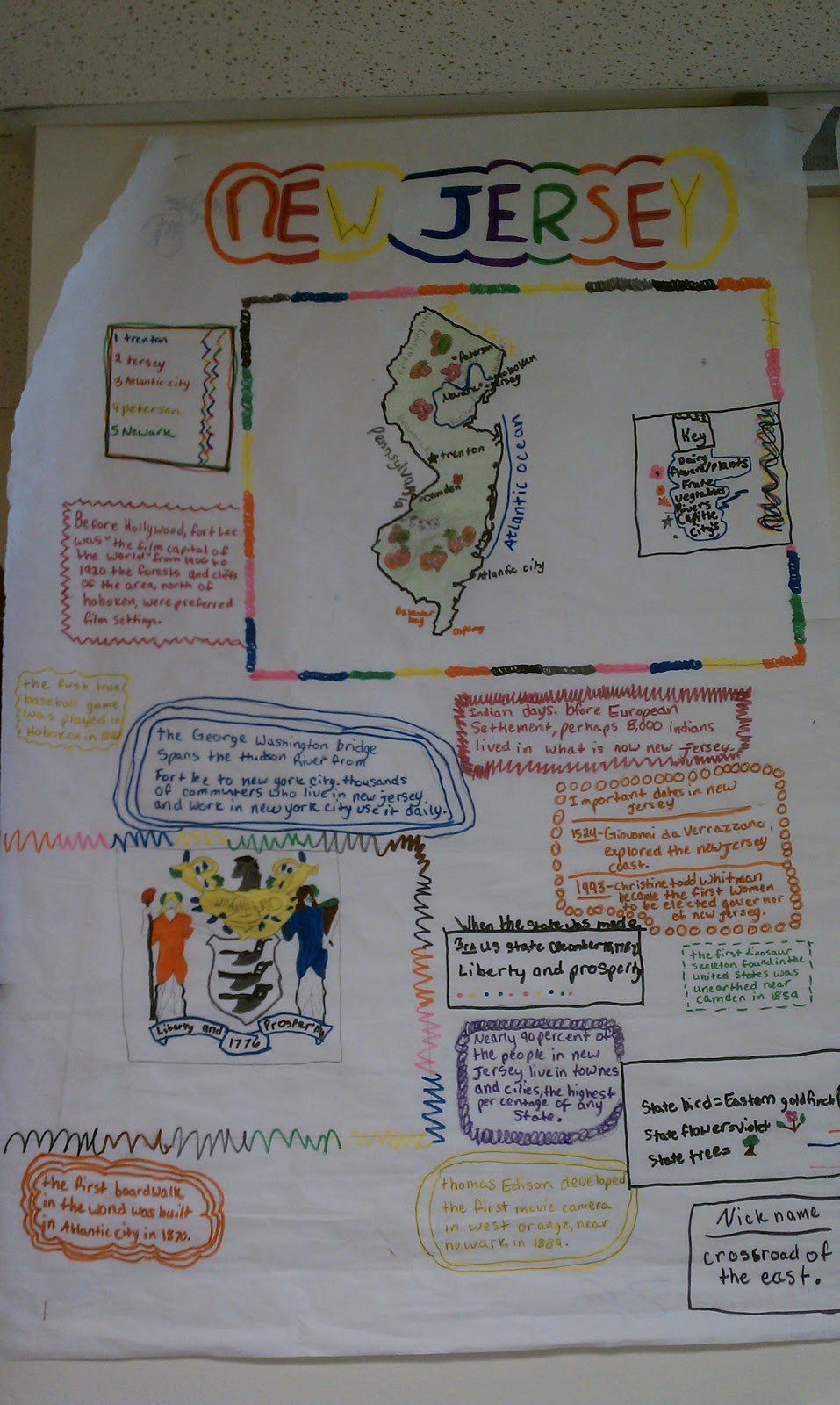
Completed 50 State Project State Strips

My class just finished their state projects, called State Strips. You can find the information on this great research project on two posts I've done, both Teaching the 50 States, and 5th Grade State Research Project: State Strips. You can access the project guidelines for this great research project here (pdf format or docx format). 

Now that the project is completed, students have also taken the time to present their posters in class. I had students prepare a 1-2 minute long speech in which they taught other students about their state. The exemplary posters were then posted in the hallway. My students love seeing their work in the hallway (and on this blog), so I'm going to show some of the great examples below. Click on any image to see a larger version. 


Monday, September 10, 2012

Update On Social Studies State Strips Project

I recently posted about our current project in social studies (as of September 10th) in a post titled 5th Grade State Research Project: State Strips. Our state strips are off and running. The due date for them in next Wednesday, which means students will have had 10 in class days to finish these projects. We're still fairly early on, but I'm seeing some great progress. Here are some photos of this great project based learning project in action:

Hard at work on Rhode Island. You can see that this student has gotten the title, and is working on facts using one of the classroom atlas books.

This picture shows how we really have to spread out to accommodate for 24 students making posters. We're using every inch of desk and floor space during social studies time, and the kids love it!


Hard at work on Texas. Notice the detail, I'm having students trace their states off of the projector.


More students hard at work with the big map in the background to reinforce the idea of where these states are located.


A great free hand drawing of Colorado's state flag.


A fantastic job so far on the state of Hawaii.


Monday, September 3, 2012

5th Grade State Research Project: State Strips

Like most teachers, I must adapt from year to year to the needs of my students. Although my 9 week plan for the year in Social Studies states that I like to do a unit on United States Geography (states and capitals) after Unit 5, this year I encountered a group of students who don't have a large background in United States geography (I blame high stakes testing, but alas, I must move on). As it's important information, at least on the surface, to learning United States history, I decided to do this unit now, before getting into United States history. This Unit on Geography focuses heavily on naming and identifying the 50 states, and a basic beginners level understanding of World Geography. By clicking on the links above, you can be taken to various resources that can assist you.

This is how it will look in my classroom:

First off, I will print off a large 3 foot by 3 foot wall map of the United States, have student help cut it out, and post it on a bulletin board in the classroom (get this from MegaMaps). As each student finishes their project, they will go and write the name of their state, and color in their state on the map.

Each student will be provided with a 3 foot by 2 foot strip of butcher paper in which to complete their project on (butcher paper is 3 feet wide, so just measure out 2 foot strips and cut).

Following the PROJECT GUIDELINES (pdf format or docx format), students will have exactly one week to complete their project, which is titled "state strips." The example in the guidelines is just something I drew up, and is nothing fancy. I make it a point to not provide them with anything too specific, because I want to see what they're capable of doing.

Sunday, September 2, 2012

Our Completed Pre-Columbian History (Maya, Inca, Aztec, Navajo) Project Posters

My class just finished our major Unit 1 Social Studies project on Thursday, and have placed the posters out in the hallway. Unit 1 is on Pre-Columbian history, and it is entirely student driven, with a project based learning project that is done in groups. Just a short 13 days into the school year, my entire class is loving Social Studies, because they get to determine their own learning within the topic of study.

Here are the guidelines and links for Unit 1, which is highlighted mainly by information on the Maya, Inca, Aztec, Navajo.

The posters themselves are great, because they're simple in nature, yet get students to work together according to the project guidelines (that document is available HERE).

Check out their great posters that are now available for viewing in the hallway outside our classroom:


Monday, July 30, 2012

Zoom Maps: A Very Simple, Very Effective Tool For Teaching Small to Large Geography or Science Relationships

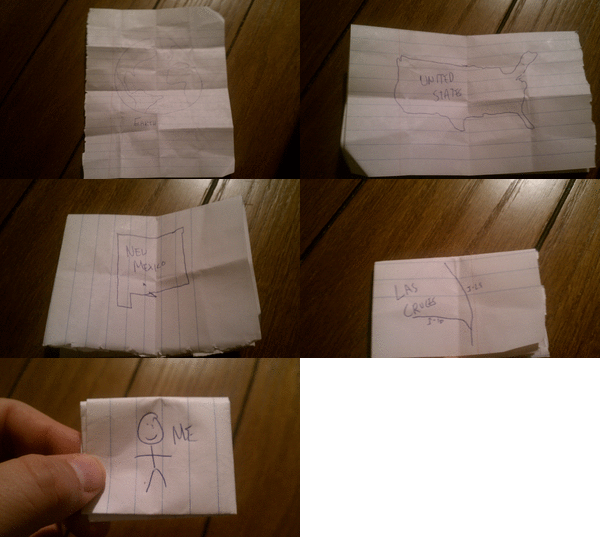
I am currently working on a unit resources page about geography. In 5th grade I teach United States geography, states and capitals, and map skills, but also briefly touch on world geography. I've noticed a disturbing trend over my career. Students in the 5th grade don't often know the difference between countries, states, and continents. They have no concept of distance (they think China is next to Mexico, etc.), and think that major cities are states (countless students have called Los Angeles a state, or California a city, or thought that Los Angeles was California). I like to include this very simple activity I call Zoom Maps. All you need for this activity is a sheet of paper, and something to write with. This is obviously an activity that can be done with much younger students, but I've found success with it in both social studies and science. I do this same foldable to "zoom in" to an atom.

Check out this example I drew up. It's very crude, but it is easy to follow. I hope to upload some student examples once school starts (August 15th here in Las Cruces). CLICK HERE FOR THE PDF DOCUMENT. Enjoy!

Also, here is an animated gif of my very simple and crude example. I made this at Picasion.


picasion.com

Sunday, July 29, 2012

World at War (World War I and World War II) Classroom Project

When I teach my 5th grade unit on the World Wars, we discuss World War I, the Great Depression, and World War II. As with each unit I teach in Social Studies, I always end with a project. In this case, it is a two part project. Students first complete a 3 dimensional display with research paper about an event from either World War I or the Great Depression, and then the entire class makes a hallway display World War II timeline. Each student is responsible for one event to place on that timeline.

I have completed and placed in my Google Drive the student information sheet for this entire project, with scoring rubrics.

Access the World at War project information sheet:

Saturday, July 28, 2012

Teaching 5th Graders About the Holocaust Through Literature

The Holocaust is one of the most difficult subjects to teach about with students who are in elementary or middle school. In fact, it could be argued that up until 5th or 6th grade, students aren't ready to begin learning about the Holocaust at all. By 5th grade, I do feel that students are mature enough to approach the subject and give it the respect it deserves, if that expectation is set from the start.

Of course, it's not really appropriate to show a class Schindler's List (you'd be fired most likely due to the R rating), so where to begin? The best place is through literature. There are many great books out there for students to read, or for the teacher to read in read aloud. In my old literacy blog, I made a posting that is very similar to this one titled Teaching the Holocaust. I will summarize a few of my favorites here:

  • The Book Thief, by Markus Zusak: This book is on my top five of all time favorite books, and was previously reviewed by me four years ago. It's listed as an 8th grade level book, but I've had some really bright 5th graders sit down and read it. It's a little long (at around 900 pages) for a read aloud, but the story is simply amazing. It's a great book to have in a classroom library. There is also a free teacher resource guide (among others) available in pdf format HERE
  • The Boy in the Striped Pajamas, by John Boyne: This story hits hard with most children. It's from the perspective of a child, it has a shocking and sad ending, and really seems to touch on the emotions of the whole thing with most kids. The movie is also quite good. Here is a link to the entire text of the book in pdf format (if you'd rather print it than buy it), and here is a teacher guide.
  • The Devil's Artihmetic, by Jane Yolen: This book was written in 1968, and is about a contemporary girl magically transported back to the concentration camps of Nazi Germany, and is forced to survive. It's a great story with a great movie.
  • The Diary of Anne Frank, by Anne Frank: One of the all-time best selling books, it needs no introduction. The material in this book and Anne Frank's story are right on for this age group. I have a post titled Teaching About Anne Frank: Classroom Resources that outlines many websites and resources to use in teaching about Anne Frank.
  • I Am David, by Anne Holm: Another book written in the 1960's, this one about a boy who escapes from a concentration camp in Bulgaria. For years it was titled North to Freedom, but is now published under its current name. The book is a little slow for use as a teacher read aloud, but the character development is good, and the movie is right there with the story line of the book.
  • Maus I & II, by Art Spiegelman: I'll admit it is a stretch to present this graphic novel to 5th graders and have them grasp the subtlety and metaphor that lies within its pages. This book is also very stark and somewhat graphic. I'm not going to argue that it's inappropriate, if I was I wouldn't mention it here, but you might want to limit it to some highly advanced students as a book study. I previously reviewed part I in a post titled Maus I: A Survivor's Tale: My Father Bleeds History, by Art Spiegelman.

Monday, July 23, 2012

Teaching About Anne Frank: Classroom Resources

I love to teach about Anne Frank every year during my unit on World War II. I just completed a list of teacher resources that I hand picked out of the many that are out there. This page is listed within my Social Studies Unit on World War II, and is titled Anne Frank Classroom Resources. To make it easier and save from all the link clicking, I will also make that unit available in this post. You can click the above link to be taken to that page, but here it is again:


When doing my unit on the World Wars, I like to discuss the Holocaust, but it's a touchy subject with elementary students. My opinion is that a 5th grader is old enough to begin learning about the Holocaust, and showing respect and concern over those events. At this age, one of the best ways to convey the gravity of the events while still making it relate able is by talking about Anne Frank. I don't have the time to read the Diary of Anne Frank in its entirety, so I have to approach it a little differently.

I begin with the reading of Who Was Anne Frank? by Ann Abramson. This book is available in my schools teacher library. I don't normally endorse things you have to pay for on this blog, but if you want to teach about Anne Frank, and don't have tons of time, this book is a good way to go.
  • The definitive Anne Frank website comes courtesy of Anne Frank .org. The Secret Annex Online is a fantastic site with a great virtual tour of the secret annex. This is one of the highest quality virtual tours I've ever seen. (trust me, there's a ton of stuff there). The site even comes with a teachers guide with information for elementary, middle, and high school teachers as to how to incorporate the site into lessons.
  • The next resource is a teacher guide that is meant to accompany the 2009 mini-series The Diary of Anne Frank. I selected this resource because of its high quality and the usefulness of many pages out of it (even without viewing the movie).
  • Up next we have the Teacher Created Resources pdf document meant to supplement Anne Frank: Diary of a Young Girl. These are a mainstay in many teachers classrooms, and can be found in teacher supply stores all over. This one includes activities, worksheets, vocabulary, and quizzes. Oh and it's free, you can't beat that price tag!
  • This next pdf is a study guide provided by Park Square Theater. It contains a good timeline, some high quality activities, and good pictures, and it's print ready. 
  • Here is a short reading with questions and an answer key in pdf format.
  • Scholastic has a teachers guide website with links to some activities and photo snapshots as well.
  • If you're looking for a quick webquest, Scholastic has this one.
Anne Frank is a very popular person for and students across the world learn about her. There are thousands of sites out there, so I could go on all day. I tried to limit this to some resources that will be helpful to me and anyone else looking to teach about Anne Frank. 

VIDEOS:

There are a number of very high quality mini-series, movies, and documentaries about Anne Frank. There obviously won't be time to watch them all, but here are some links to the ones you can view freely on Youtube (they're all big and come in multiple clips).
  • Anne Frank: The Whole Story: This 2001 mini-series closely resembles the book I mentioned above, "Who Was Anne Frank?" It stars Ben Kingsley, and is definitely classroom friendly and hits hard. If you wish to view it on Youtube, it comes in 19 parts. I'll start by embedding part one here, the easiest way to continue is to find "Anne Frank: The Whole Story Part 2 on the right sidebar, and continue on from there:

  • The Diary of Anne Frank is a 2009 mini-series, and is also very good. The approach is a little different than the above mentioned film. This one was created by the BBC, and is equally as good. I recommend watching them both, and deciding which is right for your class. It's in 8 parts, approach it the same as the one above, I have embedded part 1 here:


  • This final clip is a personal favorite, and can hardly be called a clip. The below embedded video is the entire 2 hours, 43 minutes, and 20 seconds of the 1959 classic The Diary of Anne Frank. I show this one to my class every year, and they love it. The music and black and white presentation give it an older feel, but it's very effective for fifth graders. I LOVE this movie. It's also one clip, not a bunch of different parts:


Sunday, July 22, 2012

Election Day Teacher Resources

The 2012 Presidential Elections are right around the corner. It seems like not long ago millions of Americans watched Barack Obama's historic inauguration. I watched that moment with my 5th grade class, and to this day, those kids remember witnessing history.

Of course, each Presidential Election is a major historical moment, and this upcoming one will be no exception. I came across a great online learning game a few days ago while doing one of my resource searching sessions, and it got me thinking about how I'm going to teach the election in my class this fall. 

In 2008, my school participated in the National Mock Election. I have contacted them to see when they will begin the 2012 Mock Election, their website currently isn't showing anything. I will certainly update my blog when I hear back from them or they start accepting school coordinator names again. Let me know if you've heard something I haven't!

**UPDATE**
I heard back from the people at the National Mock Election. I received this email on July 24th:


We are delighted to announce that the 2012 National Student/Parent Mock Election will be run in partnership with the Pearson Foundation.  There are some very exciting plans for moving the Mock Election into the interactive digital world of the 21st century.  We will be updating our website and trying to keep you posted as all this develops.  Please go forward with your own plans and keep us informed if you can.  We will get back to you very soon with more detailed information.  We are waiting for word from the New Mexico Secretary of State re:  continuing as the New Mexico state coordinator.

We are grateful, indeed, for your help in keeping the nation’s largest civic education project and the world’s largest national mock election alive.

We look forward with great pleasure to working with you in 2012 and to having the assistance of the foundation created by the world’s largest educational publisher.

Our website will be reorganized for 2012 next week. Hope you can start with the curriculum already up.  More soon on the exciting ways we will be expanding for 2012.

The Road to the Capitol is a flash based game that is on the National Mock Election website. It's fun, informative, and completely learning based. It can skew a little to the difficult side for your average 5th grade, but there's no reason they can't rise to the challenge. The site also includes a short 3 page teacher/parent guide in pdf format with some suggestions for mixing up the game play or enriching it.

iCivics offers a downloadable pdf activity that is a mock election classroom activity. I'm considering using this in the weeks leading up to the election, or incorporating parts of it into my schools student council elections that usually take place around the beginning of September (we'll already be in our third week of school by then). 

I came across a page of downloadable resources at Teacher Planet that all relate to the election, or could provide assistance to a school mock election.


Finally, over at Pearson Publishing, there is a great listing of classroom ready resources that students can utilize right from their site. I will be using a few of these to guide us in research and learning about the candidates. 


Friday, July 20, 2012

Print Huge Wall Sized Maps For Your Classroom

I was doing some browsing earlier, and came across a very simple website with a very awesome idea. At yourchildlearns.com, there is a page called Mega Maps, and let me tell you, these maps can be huge. Any state, country, or continent, from 1 page up to 8 pages by 8 pages (64 total pages),  you can make maps as big as you want. I highly recommend this for your map printing.

Wednesday, July 11, 2012

My 5th Grade Unit on The American Revolution

In my subject pages, I have completed a page with resources for the unit I teach on The American Revolution.
This unit includes information on life under British rule for the colonists, the growing tensions between the colonists and England, the war itself, and some bits on the reconstruction afterwards. The page is titled Social Studies Unit 3: Revolution. There are dozens of links to sites, documents, lessons, and videos.